# Your first Budokai T3 battle — a practical beginner lesson
Choose a practice opponent, learn the HUD, and build a repeatable attack, defense, and recharge routine.
Start in training, not a difficult story battle
From the main menu, look for **Ultimate Training** and its free-practice option. Translated editions may name this section differently. The original game also has lessons that explain individual techniques. In free practice, set the opponent to stand still first; then enable a low-level attacking opponent. If a mode is absent in your edition, use an easy single Duel as a fallback.
Choose **Goku (Early)** in the original English edition for this lesson and a normal-sized opponent. Keep the same character while learning. A giant, an energy-absorbing android, or a fan-mod character can introduce exceptions before you know the basic rules. Choose a standard character without custom items so results are easier to compare.
Click the game to focus it. Use Enter for Start, arrows to select, K to confirm and I to go back. In-game menu labels are part of the picture; clicking them does not activate them.
Read three different resources
The long health bar shows survival. The segmented **Ki gauge** pays for energy attacks and Dragon Dash. **Blast Stock** is a separate numbered resource used by support skills and transformations; it also matters when entering MAX POWER. Having a full Ki gauge does not mean every technique is available.
Look at the timer and whether you are locked onto the opponent. If the enemy leaves view after a big hit, search and use U (L1) before trying to attack an empty patch of scenery. Exact HUD graphics and character labels can change in fan editions.
Complete five small drills
1. **Movement:** approach with W, retreat with S and circle with A/D while locked on. Tap O to jump; use O/9 to rise or descend when flying. Learn to stop at melee range rather than running through the opponent.
2. **A clean hit:** near a standing opponent, press J three times. Release the key between taps. Watch the attacks connect before adding more buttons.
3. **A real defense:** let a low-level opponent attack. Hold L before the first frontal hit. Do not assume guard can be started freely halfway through an existing combo.
4. **A recharge window:** create distance and hold the top-row number 7. Watch the Ki gauge increase. Stop if the opponent closes in. Some characters have different energy rules.
5. **A first special:** with enough Ki and a target in front, hold 7 and press I. For Goku (Early), this selects Kamehameha in the original layout. Start from a stable position rather than during hit-stun.
Repeat each drill until you can do it deliberately. The goal is to recognize the result, not to achieve a particular damage total.
Put the drills into a short fight
Try one short attack, then watch the opponent's response. If your punches are blocked, stop extending the same string; reposition or practice a throw. If an attack sends the enemy away, decide whether to pursue or use that time to recharge. If the opponent is already rushing toward you, defending is usually a better beginner exercise than trying to finish a long charge.
Keep enough Ki for the action you actually intend to use. Constant Dragon Dash and random energy attacks spend the same resource you need for specials. A missed ultimate is not a reason to press more keys: identify whether the cause was distance, timing or the wrong state.
Choose the next lesson
Learn [supers and ultimates](/guides/special-moves/) to understand the resource conditions. Then try [three combo drills](/guides/combos/) and the [defense lesson](/guides/defense/). Use the [full controls reference](/guides/controls/) if a key does something unexpected. Save a backup after making progress in a normal game mode; practice does not replace an in-game checkpoint.
## One exchange at a time
A practice loop, not a guaranteed combo. Read the opponent before repeating it.
1. **Approach** — W A S D. Move into reach. Stop charging when the opponent approaches.
2. **Attack briefly** — J → J → J. Land a short string instead of pressing every key.
3. **Defend or reset** — L K. Guard when neutral; use a step or retreat to create room.
4. **Recharge safely** — Hold 7. Recover Ki after creating distance, then choose your next action.
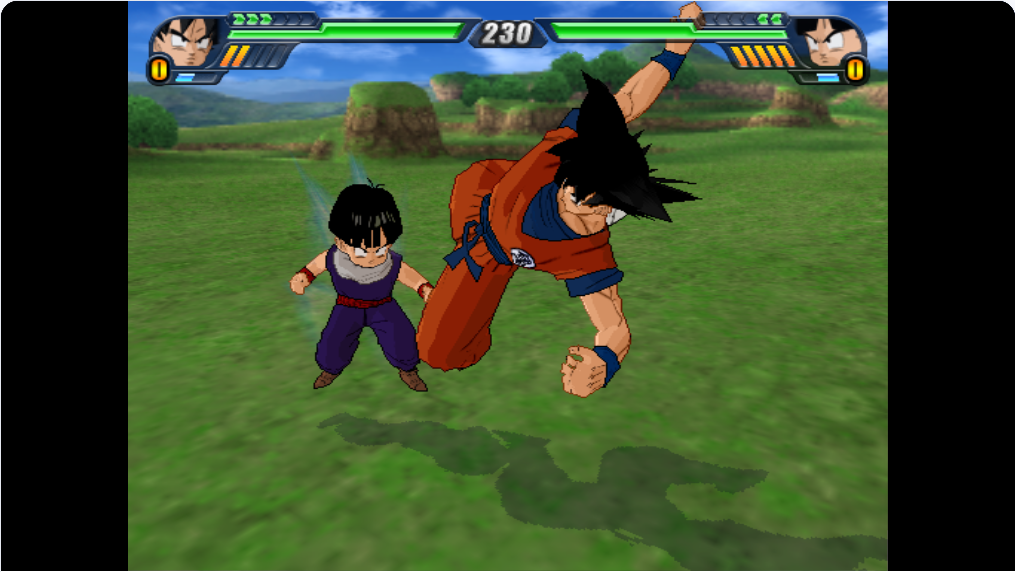
Original English edition, captured during a local browser gameplay test. Health bars sit above the Ki segments; the numbered counters are a separate resource. This is one observed fight, not a performance guarantee.
## Questions while practicing
### Why can I punch but not use a special?
Check Ki, lock-on, the selected move and whether your fighter is free to act. A punch uses J; a special needs the charge modifier 7 plus the appropriate input.
### Should I hold all the attack keys together?
No. Tap the intended attack and observe it. The same button changes meaning depending on range, previous attacks and MAX POWER state.
## References
- [Original PS2 manual — training and battle screen](https://www.gamingalexandria.com/ps2/Dragonball%20Z%20Budokai%20Tenkaichi%203/Dragonball%20Z%20Budokai%20Tenkaichi%203%20-%20Manual.pdf)
- [Port input defaults](https://github.com/stufno102/Tenkaichi3Decomp/blob/web-port/port/src/gs/gs_input.c)